How long does it take honey to dry?

James Craig
Updated on March 11, 2026
Subsequently, one may also ask, how long does it take for honey to harden?
Monitor the water temperature with a thermometer and adjust by adding hot or cool water to keep it at or below 110°F. The length of time that your honey will take to decrystallize depends upon the amount you are liquefying, but a typical honey jar takes a little over an hour to decrystallize.
Also, does honey dry out? The main reason honey doesn't go bad is because of its simple composition: honey is primarily sugar mixed with a little water. This natural, low-moisture state deters bacteria and yeast, both of which find dry environments inhospitable. Several factors determine the time it will take honey to crystallize.
Keeping this in view, how long does it take for honey to dry on your face?
about 10 minutes
Can honey mixed with water go bad?
As Harris explains, ” As long as the lid stays on it and no water is added to it, honey will not go bad. As soon as you add water to it, it may go bad. Or if you open the lid, it may get more water in it and it may go bad.”
Related Question Answers
Does putting honey in hot water destroy benefits?
As it turns out, adding honey to boiling water can change the enzymes, reducing its benefits. But what many people don't realize is that pasteurized honey has already been heat treated to kill bacteria.How do you revive honey?
First The Fix, Just Add Some Heat!- Place jar in a pot of warm water, set heat to medium-low and stir until crystals dissolve.
- Quick Fix: You could also heat in the microwave for 30 seconds, stir well, allow to cool for 20 seconds then heat again for 30 seconds (if there are still granules needing to be dissolved).
Does honey harden in the fridge?
It is not necessary to refrigerate honey. In fact, it's much easier to handle if you don't because the cooler temperature will cause the honey to solidify. This makes it difficult to use when you need it and you will have to warm it up to get it back to a liquid state.What is the difference between honey and liquid honey?
Liquid honey is basically honey's natural form: when produced by the bees and stored in the comb in the hive, honey is in a liquid state. This process creates a very smooth, even granulation effect throughout the honey, giving it a more solid, or a “creamed” texture (NOTE: there is no cream in creamed honey).Is Honey safe to eat after it crystallizes?
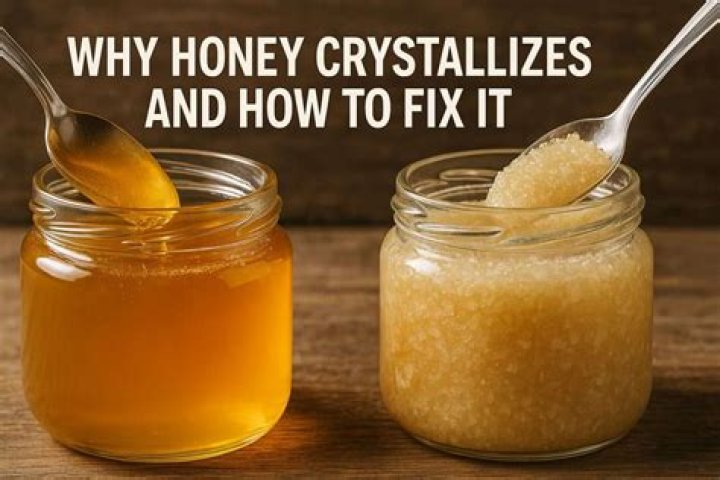
Yes, crystallized honey is safe to eat.You know honey has crystallized when it looks very thick and very grainy. It also lightens in color compared to when your honey was pourable. Crystallized honey is perfectly good to eat and preferable to many people.
Is raw honey safe?
Raw honey can contain spores of the bacteria Clostridium botulinum. This bacteria is especially harmful to babies or children under the age of one. It may cause botulism poisoning, which results in life-threatening paralysis ( 26 , 27 ). However, botulism is very rare among healthy adults and older children.How do you harden honey quickly?
Try adding a tablespoon or two of water to your honey and mixing it in. This may result in faster crystallization. Store your honey in the refrigerator. Honey stored in temperatures around 50 degrees Fahrenheit (10 degrees Celsius) will crystalize much faster.Is Honey toxic when heated?
Heated honey can actually produce delirious effects in the body and can be fatal at the same time. Cooking honey to 40 degree Celsius causes a negative chemical change that makes it taste bitter. In this case, do not heat the water and mix honey.Can I leave honey on face overnight?
#1.Mix oats and honey, leave the mixture to rest for 5 minutes until the oats soften. Then, mash the oats and mix well before applying an even layer on your face. Leave the mask on overnight as it will work to replenish moisture and repair your skin from damage done by daily exposure to free radicals while you sleep.
Can honey clog pores?
Any honey left can attract dirt, which can lead to breakouts (and the last thing you want is clogged pores and acne).Can I leave lemon and honey on my face overnight?
Answer: There is no need to leave lemon juice mask on your face overnight. Wash off your face after 20 to 30 minutes and pat it dry.Is honey is good for dry skin?
Honey is super hydrating and can bring your dry skin back to life. While you can simply apply honey on your dry skin to enjoy its moisturizing benefits, there are a lot of other ways you can use it to take care of your skin.How do you use honey as a moisturizer?
Moisturises the skin deeply:For using honey as a moisturizing mask: Use one spoon of honey on clean, dry skin, and let it sit for 15-20 minutes. Rinse with cool water. It will serve as a perfect moisturizing mask.
Can I wash my face with honey everyday?
Honey is antibacterial and antimicrobial, meaning that, as a face wash, it will kill off the bad stuff that causes breakouts and blemishes. And so, last week, I decided to take the plunge and cleanse my face twice daily — morning and night — with raw, organic honey.Can honey make skin glow?
Honey helps open the pores, helping clear away dirt. Because honey is antibacterial, it is very effective in the prevention and treatment of acne. Honey also moisturizes the skin and is a humectant, actually drawing moisture to the skin. If you want glowing skin, milk and honey are a perfect combination to use.Is honey good for lips?
Honey can help moisturize your lips and protect cracked lips from infection. It also works as a mild exfoliator and can help remove dry, dead skin from your lips. Choose organic honey, and apply to your lips throughout the day using your fingers or a cotton swab.How do you use honey as a face mask?
How to make a honey face mask.- Apply an even layer of raw or Manuka honey on damp skin.
- Leave on for 20 minutes, then rinse off with warm water. "It rinses off much more easily than you might expect!" says Plescia. "It's hardly sticky at all when you add water."
- After rinsing, follow with a cream or oil to seal in the moisture.
How can you tell if honey is spoiled?
It Can Crystallize and Degrade Over TimeIt doesn't mean it has gone bad but the process does cause some changes (1). Crystallized honey becomes whiter and lighter in color. It also becomes much more opaque instead of clear, and may appear grainy (1). It is safe to eat.
Can bacteria grow in honey?
Most bacteria and other microbes cannot grow or reproduce in honey i.e. they are dormant and this is due to antibacterial activity of honey. Various bacteria have been inoculated into aseptically collected honey held at 20°C. It is only the spore forming microorganisms that can survive in honey at low temperature.Can you use honey that has hardened?
Can I still eat crystallized (hardened) honey? Yes! When your honey has gone hard or solid, it's simply crystallized. You can still eat this honey, stir it into your tea, or even use hard honey as a gentle face scrub.How do you get honey back to liquid?
Thankfully, honey can be returned to its liquid state with little effort. Heat some water in a pot, and put your honey container in the pot of hot water until the honey turns liquid. This gentle transfer of heat to the honey helps bring it back to liquid form without overheating the honey.How long should honey sit before bottling?
24 to 48 hoursCan raw honey kill you?
In its most natural, raw form, though, honey is chock-full of toxins, and they very well may kill you. More than just one teaspoon of unpasteurized honey could be fatal. The toxins, called pyrrolizidine alkaloids (PAs), can cause liver damage and are suspected to lead to cancer.Why does my honey get thick?
The overabundance of sugar makes honey unstable. Thus, it is natural for honey to crystallize since it is an over-saturated sugar solution. The solution changes to a stable saturated form, and ultimately the honey becomes thick or crystallized.Why did my honey turn cloudy?
Honey is composed of water, glucose, and fructose. But, it is also this makeup that causes honey to crystallize and appear cloudy. The crystallization is a result of glucose molecules bonding with water molecules which then forms the crystals that can make the honey appear cloudy.Is honey as bad as sugar?
Though honey is high in sugar and calories, it's still a better choice than refined sugar. While refined sugar brings little to the table in terms of nutrition, honey provides antioxidants — including phenolic acids and flavonoids ( 3 , 4 ).Can honey go bad and make you sick?
Honey does not go bad. In fact, it's recognized as the only food that doesn't spoil. It will, however, crystallize (becoming thick and cloudy) over time. If this happens, just remove the lid from the jar, place it in a pan of water, and warm it over low heat until the honey returns to its original consistency.How long can you keep raw honey?
around two yearsDoes honey go bad or expire?
If you're considering throwing it away, think again. You don't have to toss that honey! Even if honey had been sitting on your shelf for 2,000 years, that honey would still be as good as the day you opened it. In a nutshell, well-stored honey never expires or spoils, even if it's been previously opened.Can you get food poisoning from honey?
Because it doesn't go through a pasteurization process, according to Healthline, raw honey can contain spores of Clostridium botulinum, a bacteria that is especially harmful to babies, children, and pregnant people and can cause botulism poisoning, a rare poisoning that may result in life-threatening paralysis.How can you tell good honey?
Take a teaspoon of the honey and put in a glass full of water. Fake or adulterated honey will dissolve in the water while pure honey which has a more dense texture will settle right at the bottom of the glass as lumps. The same is the case with blotting paper or a white cloth.What is the oldest honey ever found?
Ceramic jars containing the world's oldest honey (as far as archaeologists have found) — about 5,500 years old — were discovered in the tomb of a noblewoman in Georgia, not far from Tbilisi.Does water expire?
Bottled water can expireThough water itself doesn't expire, bottled water often has an expiration date. This is because plastic can begin to leach into the water over time, contaminating it with chemicals, such as antimony and bisphenol A (BPA) ( 5 , 6 , 7 ).